
The Opportunity in Digitising Pakistan’s Small Businesses
Millions of Pakistani small businesses still operate through fragmented combinations of cash, notebooks, spreadsheets, WhatsApp and social media. Connecting commerce, payments, operations and data represents one of Pakistan’s biggest opportunities for digital innovation and economic growth.
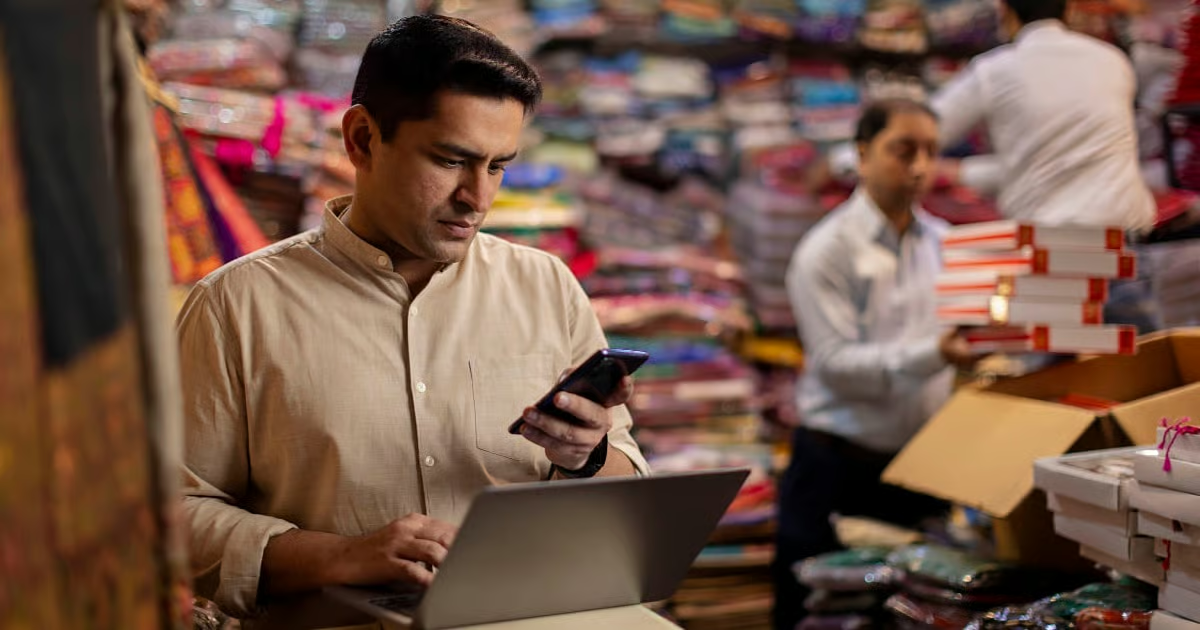
Across Pakistan, millions of small businesses form the everyday infrastructure of the economy.
They are retailers, wholesalers, restaurants, workshops, pharmacies, home-based businesses, service providers, manufacturers and independent professionals. They create employment, support families and keep local economies moving.
Yet a remarkable proportion of this commercial activity still operates through largely manual processes.
Orders arrive through phone calls or WhatsApp. Sales are recorded in notebooks. Inventory is managed from memory or spreadsheets. Payments are collected in cash. Customer information exists in personal contact lists. Invoices are created manually. Business owners often have little visibility into which products generate the most profit, which customers return or how their business is performing from one month to the next.
This is often described as a technology gap.
But it is also one of Pakistan's biggest digital business opportunities.
The next phase of Pakistan's digital economy will not be defined only by creating more consumer apps. An equally important opportunity lies in building the digital infrastructure that helps existing businesses operate better.
Small Businesses Don't Necessarily Need More Software
When we talk about digitisation, the instinctive response is often to build software.
But software itself is not the objective.
A shopkeeper does not necessarily want an inventory management system. He wants to know what is running out of stock.
A small online seller does not want a sophisticated customer relationship management platform. She wants to know which customers have ordered before and how to bring them back.
A school does not want accounting software simply for the sake of digitisation. It wants fees collected on time and payments automatically reconciled.
A service business does not necessarily want an enterprise resource planning system. It wants to send invoices quickly, know which ones remain unpaid and receive payments without repeatedly following up with customers.
This distinction matters.
The opportunity is not simply to digitise existing paperwork. It is to understand the underlying business problem and make it easier to solve.
That requires technology designed around how Pakistani businesses actually operate.
WhatsApp Is Already Part of the Business Operating System
For many small businesses in Pakistan, digital transformation has already started; it just does not look like conventional enterprise software.
WhatsApp is used for customer service, orders, quotations, product photographs and payment confirmations.
Facebook and Instagram function as store-fronts.
Banking applications and digital wallets facilitate payments.
Spreadsheets are used for accounting, inventory and customer records.
Courier portals handle deliveries.
The result is not an absence of technology. It is fragmented technology.
A business owner may receive an order through WhatsApp, manually record it somewhere else, arrange delivery through a courier portal, send bank details to the customer, receive a screenshot as proof of payment and then update another record to mark the transaction as complete.
Every individual tool may work.
The problem is that the workflow does not.
This fragmentation creates an enormous opportunity for Pakistani technology companies.
The winning products may not necessarily replace the tools businesses already use. They may connect them.
Digitisation Must Reflect Local Behaviour
Technology products developed for mature markets often assume a particular way of doing business.
Pakistan is different.
Cash remains important. WhatsApp plays an unusually central role in commerce. Many merchants sell simultaneously through physical shops, social media and online marketplaces. Customers may prefer conversational commerce over conventional checkout processes. Addresses can be difficult to standardise. Businesses often rely on couriers for cash collection. Owners may manage operations primarily through their phones rather than desktop computers.
Products designed for Pakistani SMEs must account for these realities.
A beautifully designed system that requires businesses to completely change their behaviour before receiving any benefit will struggle to achieve adoption.
A better approach is progressive digitisation.
Start with something the business already needs.
Generate an invoice.
Accept an order.
Collect a payment.
Track inventory.
Manage a delivery.
Send a WhatsApp notification.
Once a business depends on the platform for one useful workflow, additional functionality can gradually be introduced.
Digitisation becomes a journey rather than a software migration project.
Payments Could Be the Gateway to Digitisation
Payments have the potential to become one of the most important entry points for small-business digitisation.
Every business needs to get paid.
Once a payment becomes digital, it creates structured information: who paid, how much, when and potentially what the payment was for.
Connect that transaction to an invoice and reconciliation becomes possible.
Connect it to an order and the order can automatically move to the next stage.
Connect it to accounting and financial records become easier to maintain.
Connect it to customer management and a business begins building transaction history.
Payments therefore have value beyond replacing cash.
They can become part of the data layer around which other business processes are automated.
Pakistan's continued development of instant payments and interoperable financial infrastructure creates particularly interesting possibilities here. The opportunity for technology companies is to make this infrastructure invisible to the merchant: instead of asking businesses to understand payment rails, APIs and reconciliation, give them a simple button that says Get Paid.
The complexity should belong to the platform, not the customer.
E-commerce Is Bigger Than Online Marketplaces
Pakistan's e-commerce discussion frequently revolves around marketplaces.
Marketplaces are important, particularly because they aggregate demand and make it easier for merchants to reach customers.
But e-commerce should not be synonymous with marketplaces.
Businesses increasingly need to own their digital identities and customer relationships.
A merchant should be able to establish an online store-front, connect a domain, display products, receive orders, accept payments, communicate with customers, arrange delivery and understand sales performance without assembling half a dozen disconnected services.
This is where locally designed commerce platforms can create substantial value.
The opportunity is especially significant among businesses that currently sell primarily through social media.
An Instagram or Facebook page may be enough to start selling, but as order volumes increase, conversations become difficult to manage. Inventory becomes harder to track. Customers repeatedly ask the same questions. Orders get lost in message threads.
The natural next step is not necessarily a large marketplace.
It may be giving the merchant better infrastructure to run its own business.
Digitisation Creates Data, and Data Changes Businesses
One of the least visible benefits of digitisation is the creation of structured business data.
A business operating through notebooks and cash transactions may know intuitively whether things are going well, but answering relatively simple questions can be surprisingly difficult.
Which products are most profitable?
Which items remain in inventory too long?
How many customers purchase again?
Which months generate the highest sales?
What proportion of invoices are paid late?
How much cash should the business expect next week?
Digitisation makes these questions easier to answer.
Over time, this data can enable something even more consequential: access to services that depend on reliable information.
Financing is an obvious example.
Many small businesses struggle to demonstrate their financial performance through the documentation expected by formal lenders. A sufficiently rich digital transaction history can provide a much clearer picture of how a business operates.
The same principle can extend to insurance, procurement, supplier relationships and financial planning.
Digitisation therefore does not merely improve operations. It can gradually make previously invisible businesses more visible to the formal economy.
AI Could Make Business Software Dramatically Simpler
Artificial intelligence adds another dimension to this opportunity.
Traditional business software requires users to understand the software's structure: menus, forms, reports, filters and workflows.
AI increasingly allows the software to understand the user's intent instead.
A business owner should eventually be able to ask:
"How much did I sell this month?"
"Which customers haven't paid?"
"What products should I reorder?"
"Prepare invoices for these five customers."
"Which products are selling slower than last month?"
and receive useful answers or have the appropriate actions performed.
This matters particularly for small businesses.
Complex software creates training costs, and many SMEs cannot dedicate employees to learning specialised systems. Conversational interfaces could dramatically lower that barrier.
The future of SME software may therefore look less like enterprise software made smaller and more like a digital assistant that understands how the business operates.
The Economics Must Work for Small Businesses
There is, however, an important reality for anyone building technology for this market.
Pakistan's SME opportunity is enormous in volume but difficult in unit economics.
Many small businesses are price-sensitive. Customer acquisition can be expensive. Support requirements can be high. Businesses vary enormously in digital literacy. Churn can quickly undermine subscription economics.
This means successful products will need disciplined business models.
Self-service onboarding matters.
Mobile-first design matters.
Simple pricing matters.
Customer education matters.
Automated support matters.
And perhaps most importantly, the product needs to demonstrate tangible value quickly.
If software saves a business owner several hours each month, reduces failed orders, improves collections or generates additional sales, paying for it becomes easier to justify.
Selling "digital transformation" is difficult.
Selling a measurable business outcome is considerably easier.
There Is No Need for One Platform to Do Everything
The opportunity does not necessarily belong to a single super-app for businesses.
Pakistan can support an ecosystem of specialised platforms.
Some companies may focus on commerce.
Others on payments.
Others on accounting, payroll, logistics, procurement, education, healthcare or particular industries.
The critical layer will increasingly be interoperability.
Payments should connect to invoicing. E-commerce should connect to logistics. Orders should update inventory. Customer conversations should connect to customer records. Accounting systems should receive transaction information automatically.
Open APIs and integrations can allow specialised products to work together while giving businesses the experience of an integrated system.
That ecosystem could be far more innovative than expecting one company to solve every business problem.
Building for Pakistan, and Potentially Beyond It
Pakistan's constraints can also create an interesting advantage for its technology companies.
Products built successfully for Pakistani small businesses must operate in an environment characterised by price sensitivity, mobile-first users, conversational commerce, varying digital literacy, fragmented workflows and businesses transitioning gradually from cash to digital payments.
Pakistan is not alone in these characteristics.
Hundreds of millions of businesses and entrepreneurs across South Asia, the Middle East, Africa and other emerging markets face similar challenges.
A product capable of making technology simple, affordable and useful for a small business in Pakistan may eventually have relevance far beyond Pakistan.
This is why digitising local businesses should not be viewed merely as a domestic software opportunity.
It can also become a foundation for building technology companies capable of serving emerging markets globally.
The Bigger Opportunity
Pakistan's digital economy will certainly produce new marketplaces, fintech applications, consumer platforms and online services.
But some of its most important technology companies may emerge from a less glamorous proposition:
helping ordinary businesses work better.
A retailer managing inventory.
A school collecting fees.
A manufacturer tracking orders.
A freelancer sending invoices.
A restaurant managing deliveries.
An Instagram seller building an independent store.
A wholesaler keeping track of customers and payments.
Individually, these problems may appear small.
Collectively, they represent an enormous portion of Pakistan's economic activity.
Digitising these businesses can improve productivity, increase transparency, expand access to financial services and create better connections between businesses, consumers and the formal economy.
The opportunity for Pakistan's technology sector is therefore not simply to put more businesses online.
It is to build the infrastructure that helps them sell, get paid, manage operations and grow.
When digital technology becomes that practical, it stops being something a business adopts.
It becomes part of how the business works.